
Retire with Confidence
Retirement planning is about more than reaching a number.
You’ve spent decades saving for retirement. As you get closer, the questions change.
Do I have enough to retire? How much can I comfortably spend? When should I take Social Security? Which accounts should I draw from first? Should I consider Roth conversions? And what happens if the market falls shortly after I retire?
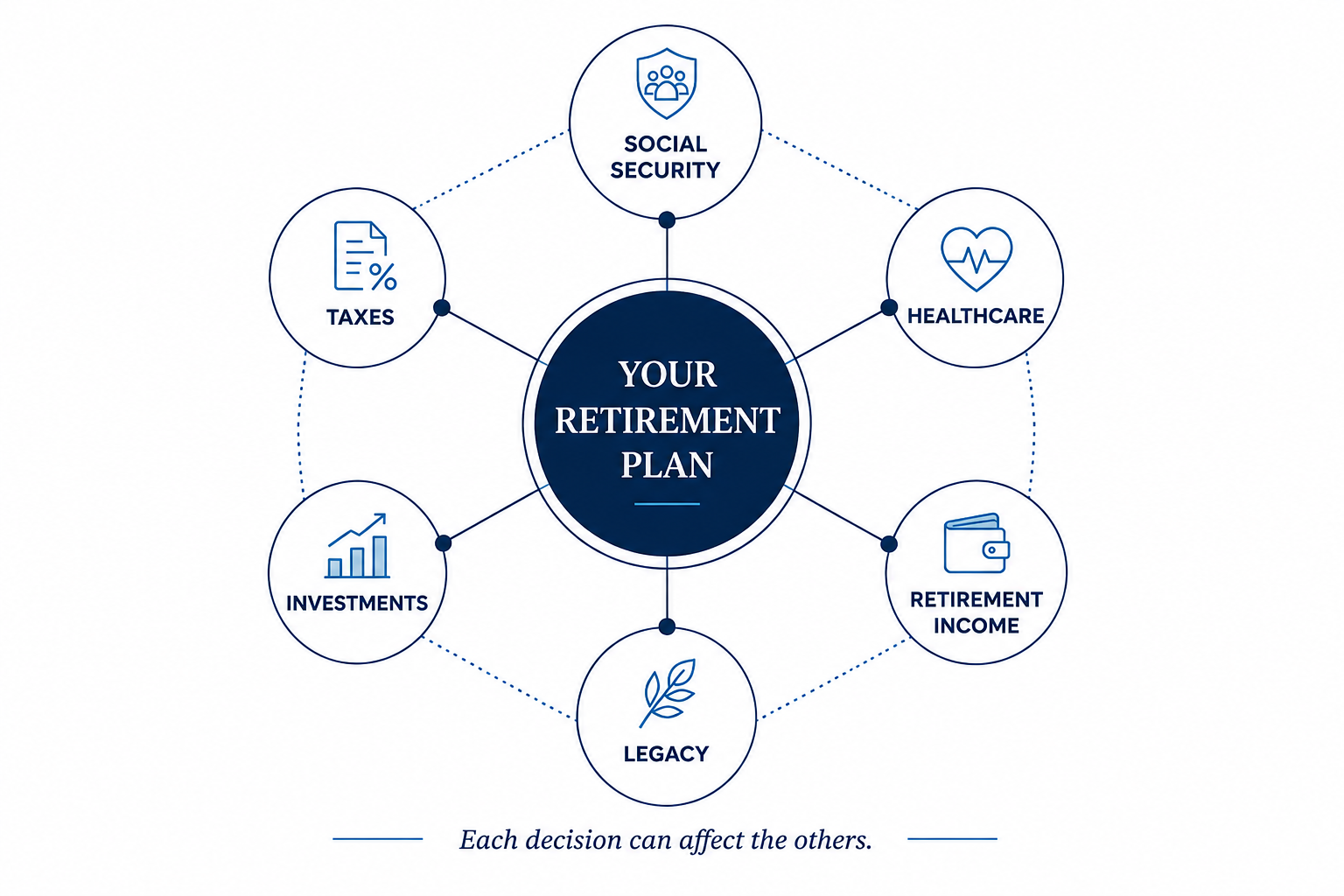
These aren’t separate decisions.
Your retirement income affects your taxes. Your taxes can affect your Medicare premiums. When you claim Social Security affects how much you may need to withdraw from your investments. And how you use those investments can affect both your current lifestyle and the assets you leave behind.
That’s why I believe retirement planning works best when we look at your entire financial picture.
My role is to help you understand how the pieces fit together, evaluate your choices and trade-offs, and make informed decisions about the retirement you want to build.
How Do I Know If I Can Afford to Retire?
You can afford to retire when your expected income and assets can reasonably support your spending, taxes, healthcare and other goals over your lifetime, with enough flexibility to withstand changes in markets, inflation and your circumstances.
EXPECTED SPENDING
TAXES
SOCIAL SECURITY
HEALTHCARE
PENSIONS + INVESTMENTS
LONGEVITY
There isn't one retirement savings number that answers the question for everyone.
A useful retirement analysis brings together your spending, Social Security, pensions, investments, taxes, healthcare and other resources and tests how they may perform under different scenarios.
What happens if… you retire at 62 instead of 65? You spend more during the first ten years of retirement? The market declines early in retirement? One spouse lives well into their 90s?
Rather than relying on one retirement “number,” the goal is to understand the range of possible outcomes and make thoughtful decisions about the things you can control.
Turning Your Savings Into Retirement Income
Saving for retirement and living from your savings are two very different financial challenges.
For most of your working life, the message is straightforward: save more, contribute to your retirement accounts, and invest for the long term.
Then retirement asks you to reverse the process and begin spending the money you worked so hard to accumulate.
ACCUMULATION YEARS
Earn → Save → Invest
Money is generally flowing into your portfolio.
That transition can be financially and emotionally difficult.
Your portfolio may now need to provide income for several decades. At the same time, you may be concerned about withdrawing too much, running out of money, or having to sell investments during a market decline.
RETIREMENT YEARS
Withdraw → Coordinate → Adapt
Your portfolio may now need to help support your lifestyle for decades.
Questions a retirement income strategy should answer:
How much can I reasonably withdraw?
Which accounts should I use first?
How much should remain invested?
How much cash should I keep available?
Where will income come from during a difficult market?
How do Social Security and pensions fit into the plan?
The objective isn't simply to generate income this year.
It's to create an adaptable strategy that connects your spending, taxes, investments and long-term goals throughout retirement.
When Should I Take Social Security?
Social Security can be one of the most important retirement income decisions you make.
The question is often framed as:
“What is the best age to take Social Security?”
But that may not be the most useful question.
A better question is:
“How would claiming Social Security at different ages affect the rest of my retirement plan?”
Starting earlier provides income sooner. Delaying can increase your monthly benefit. But the decision depends on much more than the size of the monthly benefit.
For married couples, claiming decisions can be especially important because one spouse’s decision can affect the income available to the surviving spouse later.
The goal isn’t to identify one universally correct claiming age. It’s to determine how Social Security fits into your broader retirement strategy.
WHEN TO CLAIM SOCIAL SECURITY
62
Full Retirement Age
70
Earlier access.
Lower monthly benefit.
Your full retirement benefit at your full retirement age.
Higher monthly benefit
from delaying.
The decision may depend on:
Longevity • Spouse & Survivor Benefits • Other Income • Investments • Taxes • Spending
Taxes Don’t Stop When You Retire
Retirement can create both new tax-planning opportunities and new complications.
Your retirement income may come from several different sources, and those sources can be taxed very differently.
Traditional IRA and 401(k) withdrawals are generally taxable as ordinary income. Qualified Roth distributions may be tax-free. Taxable investment accounts may generate interest, dividends and capital gains. Social Security benefits may also be taxable depending on your other income.
Later in retirement, Required Minimum Distributions can create additional taxable income from retirement accounts.
TAXABLE ACCOUNTS
Brokerage accounts
Bank accounts
May generate:
Interest
Dividends
Capital gains
→
TAX-DEFERRED ACCOUNTS
Traditional IRAs
401(k)s and similar plans
Generally taxed when withdrawn.
Required Minimum Distributions may eventually apply.
→
YOUR RETIREMENT INCOME
Where your income comes from can affect how much of it you ultimately get to spend.
Tax Decisions Can Affect More Than Taxes
A decision that looks attractive from an income-tax perspective can sometimes create consequences elsewhere.
For example, additional income from a Roth conversion, retirement-account withdrawal or realized capital gain could potentially affect your Medicare premiums.
Tax decisions can also affect the timing of Social Security, future Required Minimum Distributions, investment decisions, and the assets ultimately left to a spouse or heirs.
ROTH ACCOUNTS
Roth IRAs
Roth 401(k)s
Qualified withdrawals may be tax-free.
RMD rules may apply depending on the type of Roth account.
→
Questions Worth Considering
Which accounts should I withdraw from first?
Should I take IRA distributions before they are required?
Would a Roth conversion make sense?
Should I realize capital gains during a lower-income year?
Could additional income increase my Medicare premiums?
How might today’s tax decisions affect a surviving spouse?
Good retirement tax planning isn’t simply about minimizing this year’s tax bill.
Sometimes paying more tax today can create greater flexibility later. In other situations, deferring income may be more appropriate.
The objective is to evaluate tax decisions over time and coordinate them with the rest of your retirement plan. When appropriate, that work should also be coordinated with your tax professional.
How Should My Investments Change in Retirement?
Retirement doesn’t necessarily mean becoming a conservative investor overnight.
Your portfolio may still need to grow because retirement could last 25 or 30 years, or longer. At the same time, market declines can become more consequential when you’re withdrawing money rather than adding to your accounts.
The important question isn’t simply, “How much risk should I take?” It’s “What does my money need to do for me now?”
That is why your investment strategy should connect directly to your retirement income plan.
Sooner
NEAR-TERM NEEDS
Money needed sooner
Liquidity + Stability
INTERMEDIATE NEEDS
Money needed in the years ahead
Growth + Stability
Different parts of your portfolio may have different jobs to do.
Later
LONG-TERM NEEDS
Money not expected to be needed for many years
Growth + Purchasing Power
Why the Timing of Market Returns Matters
A market decline can affect a retiree differently than someone who is still working and contributing to their accounts.
If you are withdrawing from declining investments, you may need to sell more shares to generate the same amount of income. That can leave fewer assets available to participate in a future recovery.
This is known as sequence-of-returns risk, the risk that poor investment returns occurring early in retirement can have an outsized effect when combined with ongoing withdrawals.
The goal isn’t to eliminate market risk. It’s to build a retirement strategy that recognizes it.
Questions Your Investment Strategy Should Answer
How much money may I need during the next several years?
How much can remain invested for longer-term growth?
What level of market volatility can my retirement plan reasonably withstand?
Where would income come from during a prolonged market decline?
Is my portfolio appropriately diversified?
Do my investments reflect both my ability and my willingness to take risk?
Your investments shouldn’t exist separately from your retirement plan.
The objective is to build an investment strategy that supports your income needs today while preserving appropriate opportunities for growth over what could be a long retirement.
Medicare and Healthcare Costs
Healthcare is an important part of the retirement equation—and Medicare does not eliminate healthcare expenses.
If you retire before becoming eligible for Medicare, one of the first questions is how you will cover healthcare during the gap. Once you are enrolled in Medicare, premiums, supplemental coverage, prescription costs and out-of-pocket expenses still need to be incorporated into your retirement plan.
There is another connection that is easy to overlook:
Some financial decisions can affect what you pay for Medicare.
BEFORE MEDICARE
How will I cover healthcare?
Retiring before Medicare eligibility may require several years of alternative health coverage.
MEDICARE
What should I budget for?
Premiums, supplemental coverage, prescription costs and other out-of-pocket healthcare expenses can continue throughout retirement.
Healthcare decisions and financial decisions often intersect.
INCOME + MEDICARE PREMIUMS
Could financial decisions affect what I pay?
Higher income can result in higher Medicare Part B and Part D premiums for some retirees.
Your Retirement Date Matters
Retiring before Medicare eligibility creates an additional planning question: how will healthcare be covered between retirement and Medicare?
The cost of that coverage can affect how much you need to save, how much you can comfortably spend, and sometimes whether retiring earlier is financially practical.
Your Income Matters Too
Medicare Part B and Part D premiums can be affected by income. That means a large Roth conversion, retirement-account withdrawal or realized capital gain could potentially increase Medicare premiums in a future year.
This doesn’t necessarily mean you should avoid those decisions. It means the Medicare impact should be considered along with the potential benefits.
Healthcare planning shouldn’t happen separately from retirement planning.
Your retirement date, expected healthcare costs, income, taxes, investment withdrawals and long-term-care considerations can all affect the amount of flexibility you may need in retirement.
Retirement Planning Is a Series of Trade-offs
Many retirement decisions don’t have one objectively correct answer. The right choice often depends on what you value, what you’re willing to give up, and how one decision affects the rest of your financial life.
RETIRE EARLIER
More time and freedom now ↔ Your assets may need to support you longer
DELAY SOCIAL SECURITY
Potentially higher future monthly benefit ↔ Greater reliance on other resources today
ROTH CONVERSION
Potential future tax flexibility ↔ A tax cost today
HOLD MORE CASH
Greater short-term stability and liquidity ↔ Less opportunity for long-term growth
Good retirement planning isn’t about eliminating trade-offs.
It’s about understanding them.
Retiring earlier, delaying Social Security, converting an IRA to a Roth, paying off a mortgage, holding more cash, or helping family can all create benefits and costs.
When you can see how one decision affects the rest of your financial life, you can make choices based on what matters most to you rather than simply following a rule of thumb.
What If Life Doesn’t Follow the Spreadsheet?
A retirement plan doesn’t need to predict the future.
It needs to help you adapt to it.
No financial plan can predict exactly what will happen over the next 20 or 30 years.
Markets change. Tax laws change. Inflation changes. Families and priorities change.
You may decide to travel more. Move to another state. Buy or sell a home. Help a child. Sell a business. Receive an inheritance. Face an unexpected expense. Lose a spouse. Or simply discover that retirement looks different than you originally imagined.
That’s why I don’t view retirement planning as a one-time calculation.
A useful retirement plan provides a framework for making decisions. And then it evolves as your life evolves.
The question isn’t whether every assumption in the plan will turn out to be correct. They won’t.
The important question is whether you have a process for recognizing changes, understanding their impact, and adjusting thoughtfully.
How I Approach Retirement Planning
Retirement planning starts with understanding where you are today, what you want retirement to look like, and the decisions that stand between the two.
Rather than looking at investments, taxes, Social Security and income separately, I use a planning process designed to bring those pieces together.
01 — UNDERSTAND
Where you are today.
Goals, priorities, resources and concerns.
02 — IDENTIFY
The decisions ahead.
Retirement timing, income needs and opportunities.
03 — MODEL
Different paths forward.
Scenarios, trade-offs and potential outcomes.
04 — IMPLEMENT
Put the strategy into action.
Coordinate the decisions you choose to make.
05 — REVIEW & ADJUST
Keep the plan current.
Monitor progress and adapt as life changes.
The goal is not simply to create a retirement plan. It’s to create a decision-making process you can continue to use throughout retirement.
Retirement planning is ongoing. As markets, tax laws, family circumstances and your priorities change,
the plan should evolve with them.
Who I Work With
I work with individuals and families who want to make thoughtful financial decisions as they approach retirement and throughout the years that follow.
You don’t need to have every question figured out before we talk. Often, the reason to begin planning is that several important decisions are starting to overlap.
You don’t need to have every answer before you begin planning.
You need decisions important enough to deserve thoughtful attention.
APPROACHING RETIREMENT
You can see retirement on the horizon, but you want to know whether the pieces really fit.
When can I afford to retire?
How much can I spend?
When should I take Social Security?
How should my investments change as retirement gets closer?
RECENTLY RETIRED
You’ve made the transition from earning and saving to relying more on the assets you’ve accumulated.
Now the questions may be about withdrawals, taxes, investments, Medicare and how to make your resources last.
NAVIGATING CHANGE
Retirement rarely happens in isolation from the rest of life.
A job change, inheritance, sale of a business, loss of a spouse, move, health event or change in family priorities can create new financial decisions that need to be considered together.
Retirement Planning FAQs
Retirement brings together decisions about income, investments, taxes, Social Security, healthcare and the life you want to live. Here are answers to some of the questions I hear most often.
-
There isn’t one retirement savings number that works for everyone. Whether you have enough depends on your expected spending, Social Security and other income, investments, taxes, healthcare costs, longevity and the lifestyle you want to support.
A retirement plan can bring those factors together and model how your resources may hold up under different assumptions and market conditions.
-
A sustainable spending level depends on more than a standard withdrawal percentage. Your age, portfolio, other income, taxes, expected longevity and willingness to adjust spending can all matter.
Rather than relying on one rule of thumb, retirement income planning can help determine a reasonable starting point and provide a framework for adjusting spending as circumstances change.
-
There is no universally best age to claim Social Security. Starting earlier provides income sooner, while delaying can increase your monthly benefit up to age 70.
The decision should also consider your health and longevity, other retirement income, investments, taxes, and—for married couples—spousal and survivor benefits. The goal is to determine how Social Security fits into your overall retirement strategy.
-
There is no withdrawal order that is best for everyone.
Taking money from taxable accounts, tax-deferred retirement accounts and Roth accounts can have different consequences for income taxes, future Required Minimum Distributions, Medicare premiums and the assets you leave behind.
A coordinated withdrawal strategy considers both your current income needs and the potential longer-term tax impact.
-
A Roth conversion can make sense in some situations, particularly when your current tax rate may be lower than the rate you expect to pay later. But converting creates taxable income in the year of the conversion and can affect other financial considerations, including Medicare premiums.
The decision is usually better evaluated over multiple years rather than simply asking whether a Roth conversion saves taxes this year.
-
Retirement doesn’t necessarily mean becoming a conservative investor overnight. Your portfolio may still need long-term growth to help support a retirement lasting several decades and keep pace with inflation.
At the same time, withdrawing from investments during market declines can create additional risk. Your investment strategy should reflect your income needs, time horizon, ability to withstand volatility and need for long-term growth.
-
Healthcare costs vary considerably based on when you retire, your coverage, health needs and income.
If you retire before becoming eligible for Medicare, you may also need to fund several years of alternative coverage. After Medicare begins, premiums, supplemental coverage, prescription costs and other out-of-pocket expenses should still be included in your retirement budget.
-
Ideally, retirement planning begins several years before you expect to retire, while you still have time to evaluate choices involving savings, investments, Social Security, taxes and healthcare.
But there is no point at which it is “too late” to benefit from planning. If you are already retired, a retirement plan can still help you evaluate spending, withdrawals, investments, taxes and decisions as your circumstances change.
Ready to Talk About Your Retirement?
You don’t need to have every decision figured out before we talk.
If you’re approaching retirement, recently retired, or simply trying to understand how the pieces of your financial life fit together, an introductory conversation can be a good place to start.
No obligation. Just a conversation about where you are, what’s on your mind, and whether I may be able to help.
Based in New Jersey, I work with clients in New Jersey, New York, and other states where properly licensed.